
John Hurrell – 4 September, 2026
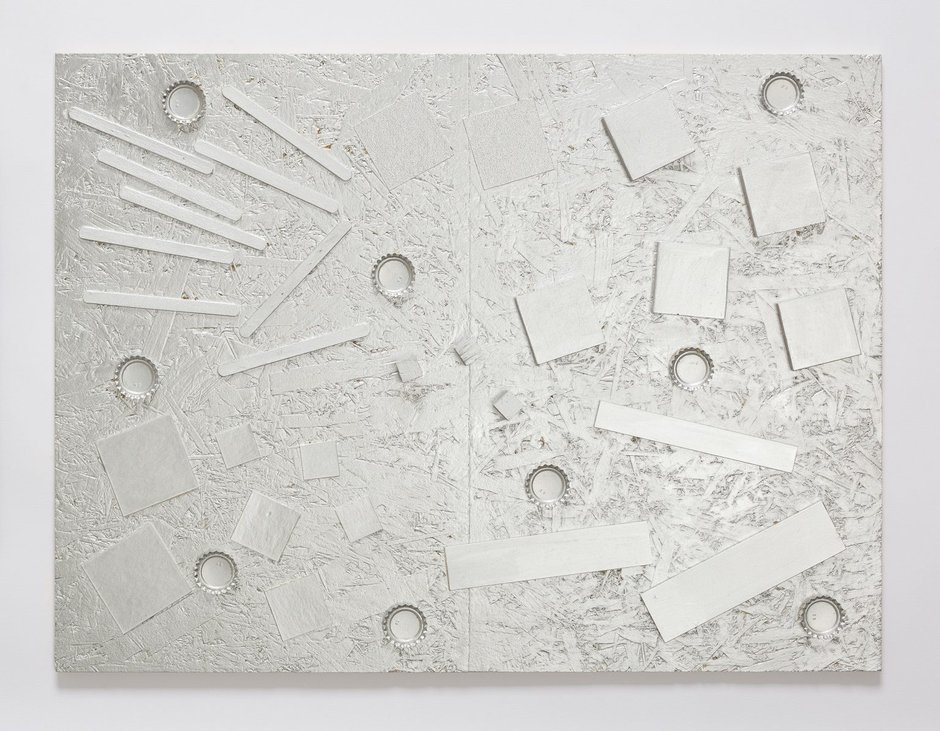
The abbreviating condensation to three titling capital letters obviously has rhetorical punch. Whilst the dense coat of unstable evanescent ‘grey-white' metallic paint effortlessly obliterates all the colour it covers, it also generates something else: a new sort of dramatic surface-based space projected out from their fronts, one that tends to hover over absorbedly, or advance towards you—determinately opaque and stridently not retreating back through the supporting wall of the gallery.
Light bouncing off carefully positioned highly reflective silver enamel paint on projecting collage is the focusing preoccupation of these textured and spatially ambiguous paintings by the late John Nixon (1949-2020), with their glittering heavily tactile surfaces and stuck on elements such as broken glass, wooden strips or bottle-tops. The rectangular bases are made of laminated strandboard.
Here in Two Rooms, the works from this international Melbourne conceptualist are presented collectively as twenty-one products from an EPW (Experimental Painting Workshop). The show has been expertly curated by his partner Sue Crammer and has considerable focus. The works were made between 2003 and 2009.
The abbreviating condensation to three titling capital letters obviously has rhetorical punch. Whilst the dense coat of unstable evanescent ‘grey-white’ metallic paint effortlessly obliterates all the colour it covers, it also generates something else: a new sort of dramatic surface-based space projected out from their fronts, one that tends to hover over absorbedly, or advance towards you—determinately opaque and stridently not retreating back through the supporting wall of the gallery.
Also the round bottletops in combination (like circular ‘islands’) set up a floating grid that uses the straight lines of the wooden bits around them as an effective foil.
This way, with their seemingly simple elemental composition, carefully chosen symbolic covering materials and historic references, and accompanying contextual rhetoric, they become slyly confrontational and raw, being openly challenging as ongoing claims for current ideational relevance. They celebrate an unstable constantly-shifting opticality, while displaying an effective/affective exhibiting strategy that is rich in associations, like say aerial landscape photography.
John Hurrell
 Two Rooms presents a program of residencies and projects
 Advertising in this column

This Discussion has 0 comments.
Comment
Participate
Register to Participate.
Sign in
Sign in to an existing account.