

Peter Dornauf – 11 September, 2026
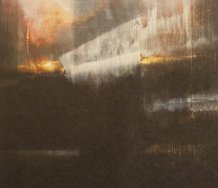
Where is this light coming from? It originated, of course, from the core of the sun. That journey will have lasted thousands of years as it made its way here eventually from the surface of the star. Light that hit the film strip also came from other planets that travelled around the solar system to enter the earth's atmosphere and deposit a few photons on the antique emulsion of the film. This is camera-less photography, just one of many technical processes Lisa Benson employs.
The Impressionist painters of the mid to late nineteenth century were fascinated by the play of light and the surface of objects. Light and its changing aspects became the focus. Recall Monet’s haystacks.
In the twenty-first century New Zealand photographer Lisa Benson has the same single-minded absorption. Light as it plays, manifests and exhibits itself in a variety of contents—a subject that captures and enchants the artist. The difference here with Benson, in contrast with the painters, is the medium used and the philosophical implications involved. Added to that, the product and output is entirely abstracted.
Looking at some of her recent works exhibited at Ramp Gallery in Hamilton, entitled Stellar Garden, one cannot help but be reminded of that other New Zealand artist and photographic experimenter, Len Lye, who was also captivated by light, begun when he was just a boy—mesmerised by seeing light glinting of the surface of a tin can that he was kicking down the street. In his famous work, Free Radicals, he simply used raw film strip, and scratched designs on the black film stock, which when played through a projector revealed dancing abstract patterns on a screen. Quirky, kinetic, impish, frolicsome and mischievous.
In comparison, Benson presents a more serious tone and deeper analysis. Hers is a more cosmological inquiry. And process, lengthy process, is fundamental to her work, particularly one called Hypersensitive II - IV. She begins with a dinted roll of antique 35 mm film frame (circa 1960-70) and sets it up in a north-facing window for several months to gather light.
Where is this light coming from? It originated, of course, from the core of the sun. That journey will have lasted thousands of years as it made its way here eventually from the surface of the star. Light that hit the film strip also came from other planets that travelled around the solar system to enter the earth’s atmosphere and deposit a few photons on the antique emulsion of the film. This is camera-less photography, just one of many technical processes she employs.
Thus the engagement of her art focusses on our place in the universe, a subject few tackle today, preoccupied as they are with political matters. It speaks to our transience as it confronts us with gargantuan distances and time. The light-gathering process reflects on our insignificance in the grand scheme of things. We are, as American writer Don Delillo has one of his characters say (in the novel, Underworld) ‘lost specks’.
We used to have the same dimensions as the universe but now we are helpless dots of dust, subsumed by the enormities we face. It’s big out there. Oceans of it lapping the shorelines of the mind.
The second process is the darkroom, which again involves the operation of both light and chemistry. At some point these processes, staple gun perforations, were added to the film-strip to help congregate the light. The results are then enlarged and handprinted on paper.
And the final look of it? Slightly spooky. Are these UFO sightings captured in some darkened night sky? Could they be random atoms picked up via some electron microscope? Or something more sinister? They are, in fact, dissertations on time and space, those favourite co-ordinates loved by contemporary physicists who brought us all the modern conumdrums of the quantum world with their Alice In Wonderland enigmas.
This is our stellar garden, the place we inhabit where our consciousness has been startled within the last hundred years, after Einstein and Hubble got to work and left us feeling slightly puzzled, stranded and unhinged. Our whole perception of who we are, where we are and how to stand within it has been radically affected.
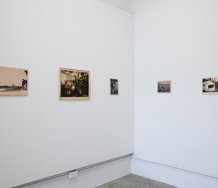
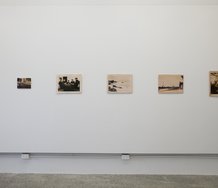
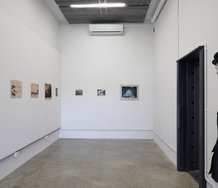
Benson’s work via her abstract photography, throws into sharp focus elements to do with matter, energy, space and time. Can some coherence be made, hopefuly coming to terms with the mystery and wonder of it all? Similar explorations and experiments have been conducted by Benson that deal with imagery related to solar eclipses and rainbows, obtained through a variety of photo-gathering mechanisms. These are exhibited on the walls of the gallery in a linear and repetitive pattern, appositely reminiscent of some scientific project or display.
Light is our primary element. “And God said, “Let there be light.” This was the first article of creation and we are still trying to come to terms with its discrete packets of energy. Benson has, both in her processes and format, created a unique celestial landscape to promote contemplation for modern viewers who have been bumped from the Garden of Eden and abandoned to the grand enormity of the cosmic garden.
Peter Dornauf
 Two Rooms presents a program of residencies and projects
 Advertising in this column




This Discussion has 0 comments.
Comment
Participate
Register to Participate.
Sign in
Sign in to an existing account.