
Ralph Paine – 26 October, 2026
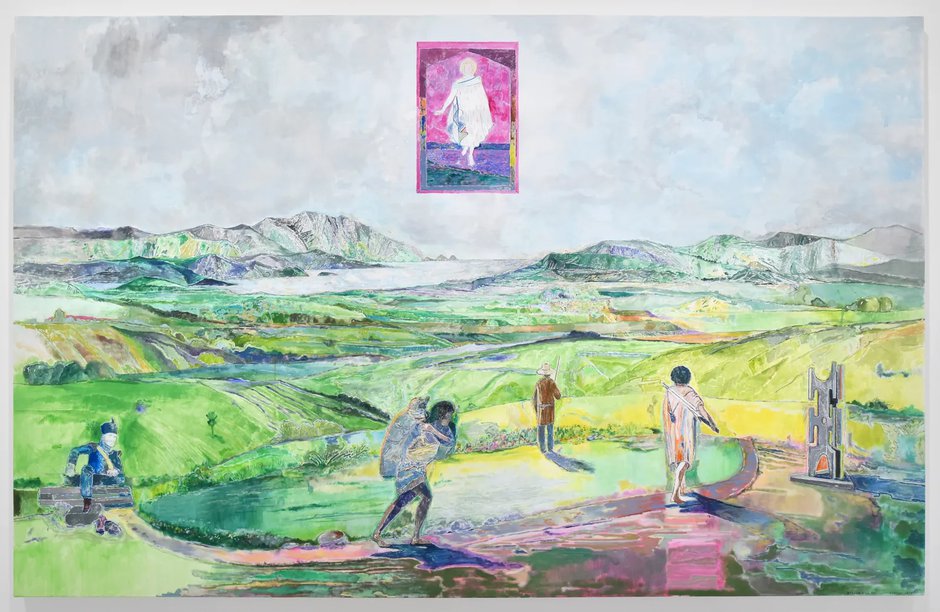
With Stained Glass Sky, 2026, Cotton has rendered a version of Earle's Distant View at very large scale. There are compositional alterations in this work, spatial mutations, deletions and additions (is that von Tempsky climbing over a stone wall in the lower left?) but for sure there's no sombre effect. Along with a diminished planar/atmospheric perspective, the fixed light source has vanished somewhat, and this despite the figures' unidirectional shadows. It's as if Cotton's eye and the sun (the stained-glass window) have fused. And then multiplied.
Shane Cotton
14 October - 14 November 2026
For a long time I used to holiday in Te Tai Tokerau. The last stay, a couple of summer weeks at Tapeka Point Beach, just over the hill from Kororareka. I had with me an A4 colour printout of Augustus Earle’s remarkable painting The Meeting of the Artist and the Wounded Chief Hongi at the Bay of Islands, November 1827. Although executed in London circa 1835, Earle composed the work using sketches made while in Te Tai Tokerau, 1827 - 28. Somewhere I’d read that the meeting between the artist and the wounded chief had taken place at Tapeka Point Beach. So, printout in hand, at low tide one day I wandered the western end of the beach in search of the precise location of the famous meeting.
I found the place, but things were kinda slant. Between the printed image and my POV, many disproportions, distortions, and full-on imbalances arose. The profile of the eastern headland and the rocks below seemed closer in the image; the sweep of the beach way smaller in the image; the slope of the hill rising behind the beach steeper in the image; and all-out crazy, the beautiful little cove half-encircling the seated and standing figures in the image had completely disappeared. I get it that an early 19th century oil painting ain’t no similitude, but hey, the little cove’s disappearance had me puzzled, disoriented. In a nice sun-kissed kinda way.
∞
The person who contemplates a landscape is lost, happily lost. “That person no longer seeks to comprehend, only looks.” (Giorgio Agamben, Creation and Anarchy, p. 49). There’s a sense with Cotton’s recent work that he is lost. Happily lost. Immemorially lost. That he no longer seeks to comprehend but is only looking, as if interpretation, preparation, and learning are now diffused into his idyllic, painted deliria. Guess this is when knowing becomes intuitive: whatumanawa.
∞
Elstir’s effort to strip himself, when in the presence of reality, of every concept of his intelligence was all the more admirable… He strove to paint things not as he knew them to be, but according to the optical illusions of which our first vision is made.
-Marcel Proust, ‘Place Names: The Place.’
∞
Or, perhaps Cotton is always already lost. Always already painting inner visions, hallucinations, third eye stuff. Figure though there’s been an intensification of this mode. Call it a late style, or the result of a deterritorialization-reterritorialisation (from Manawatu to Te Tai Tokerau), whatever, but no doubt a shift in register has happened, a reverie now in ultra-abandonment: drifting brain-eye-brush.
∞
OK, so no attempts at surpassing of the work toward some transcribed meaning; no constituting the work as representation; no recognition of the work as the expression of a subject. Rather: depersonalisation, collective expression, a kinda transindividual magic. Yeah, and with Cotton as relayer. Relayer among relayers - among “a people of relayers.” (Deleuze and Guattari, A Thousand Plateaus, p. 377).
∞
None of which is to say that the Cotton-effect is not a singular event. Only that this event folds, unfolds, refolds a multiplicity of other events. These having arrived from elsewhere. Hence the importance of the concept of the Natal, the indigenous. It is said that every autochthonic territorial assemblage presupposes an elsewhere, an intimate and intense outside-within. For pre-contact iwi this was Hawaiiki, a mythic and paradisical ‘place’ - abstract yet at the same time real - whence the ancestors came. Hawaiiki-as-Cosmic Refrain. Totally revitalised and celebrated today yet fused now with a way different outside-within: globalised commercial/cultural circuits. To paint the wild and perilous times of this fusion.
∞
In the beginning, the copy… Thus, simulacra and serialisation. The endless repetition with a difference of myriad signs, numbers, patterns, and cyphers - whatever lies at hand. Manaia and pop vibes. Plants and laughing trees. Falling birds and demons. Mokomokai. Graffiti and barren hills. Sailing ships. Airbrushing. Amphora and pou. Modernist feels. Digital readouts. Tiki and muskets… From one drawing/print/painting/object to another, Cotton appropriates, samples, gleans, reuses, recycles: a bricolage machine.
∞
40.
what
to
expect
?
eh
-Kendrick Smithyman, Atua Wera.
∞
Journal entry… Thursday 24 October 2024. Train to Onehunga - Shane Cotton, New Painting @ Gow Langsford. Not knowing what to expect, walked in and was instantly swept away. As if on magic puha. The colour, Northland, the Augustus Earle thing, the James Barry/Thomas Kendall thing, mystic portals, radiance… Is the first prophet Atua Wera? I kept returning to Ahuaiti’s Cave: intense flash back of the sea cave at Awahoa Bay. Cotton-as-seer!
∞
Indecisive, the brain-eye-brush assemblage stumbles, stutters. Its tracings flicker, speed up ‘n’ slow down. Colour patches wobble ‘n’ waver, blend in then break off. Everything’s aquiver. Restless. Earth flux, orange flux, pink flux. Deep deep shadow and white… Liquid lines, the gestation of a gaze. The current Gow Langsford exhibition feels like a refreshed edition of the Onehunga one. It’s the genesis of the same landscape, with similar effect, but contracted on the paintings’ surfaces many new events and encounters appear. Different regimes of colour. Magnificently fresh ancestor figures, complexes of pattern, signs and wonders e.g. rough-as renderings of the carved pulpit eagle and stained-glass window at St Faith’s Anglican Church in Rotorua; slightly crisper renderings of a modernist sculpture (Arnold Wilson?).
∞
One of Delacroix’s greatest moments: give me a heap of mud, and I will bring out an exquisite colour.
-Gilles Deleuze, On Painting.
∞
There are works in the current exhibition that equal Delacroix’s claim. From heaps of mud, Cotton brings out exquisite colours. Burnt orange, violet, forest green, fuchsia pink, shades of turquoise… These paintings feel like some of Cotton’s greatest moments.
∞
Abounding in symbols (tiki, eagle, target, window, etc.) the current exhibition feels positively symbolist. But what is a symbol? What does a symbol do? For D. H. Lawrence, symbols (or what sometimes he names ‘images’) are cosmic thing-signs, and as such enact whole clusters of changing and deepening affects and immanent relations. Symbols are practico-performative, and what they perform is a dynamic and ever-increasing becoming-conscious, becoming-aware. In Lawrence’s sense symbols have no fixed meaning. Rather, a symbol is an intensive compound, a mysterious point, an abstract zone of potentiality around which thought turns - around which thought is turned. (See D. H. Lawrence, Apocalypse, pp. 91 - 94).
∞
In Frames on the Land, Francis Pound describes the “effect” of Augustus Earle’s 1827 water colour Distant View of the Bay of Islands as one of “sombre splendour.” With Stained Glass Sky, 2026, Cotton has rendered a version of Earle’s Distant View at very large scale. There are compositional alterations in this work, spatial mutations, deletions and additions (is that von Tempsky climbing over a stone wall in the lower left?) but for sure there’s no sombre effect. Along with a diminished planar/atmospheric perspective, the fixed light source has vanished somewhat, and this despite the figures’ unidirectional shadows. It’s as if Cotton’s eye and the sun (the stained-glass window) have fused. And then multiplied. Light effects are dispersed right across the panoramic surface, a web of rapidly brushed lines, hatchings, patches. The colours are both intensely bright and soft, and somehow everywhere at once, right across the surface, to some degree. And all echo, to some degree, all the others. There is no lack, only a shimmering field of immanence, plenum of colour and light effects. Cotton stares at the sun/son and his vision flickers, vibrates between different poles of attraction: contemplation and deed, sky and whenua, history and the untimely (an escape from history). Yet these restless shimmers and vibrations are simply different states of a natural energy: landscape.
Ralph Paine
 Advertising in this column
 Two Rooms presents a program of residencies and projects


This Discussion has 0 comments.
Comment
Participate
Register to Participate.
Sign in
Sign in to an existing account.