
John Hurrell – 8 November, 2009
Like visitors to the cage, these real-life (unidentifiable) prisoners are documented discovering qualities in the instruments they explore – making sounds that happen to fit into the genres of punk, improv or free noise.
Auckland
Daniel Knorr and Prisoners of New Zealand
Block
4 November - 28 November 2009
One of my favourite examples of sixties ‘conceptual art’ (so-called) is by the Dutch artist Jan Dibbets, a project discussed in Lucy Lippard’s well known book Six Years: The Dematerialization of the Art Object. In this work Dibbets positioned three poles on the edge of a forest in an attempt to extend the territory of a robin. The sculpture (Robin Redbreast Territory/Sculpture 1969) only came into existence when the small bird happened to fly into the triangular space between them.
In his current exhibition at ARTSPACE Berlin-based Daniel Knorr has a similar approach to making transient and temporary sculpture. In the main square gallery he has built an elegant circular cage of bars and curved roof. In it he has placed six classical instruments: a harp, double bass, cello, violin, timpani, and flute. The door providing access to them is locked.
This construction looks great in the gallery but despite its attractiveness and its location, it is not an artwork. Knorr has decided that it only becomes an artwork when a visitor who is not a trained musician goes to the office, gets the key to the door, enters and starts to experiment with the instruments. Once they start testing the sounds within each one, learning how to manipulate the aural qualities they discover, their actions and sounds are an art experience for other visitors.
If an educated (or knowingly gifted) musician gets in the cage and performs – it won’t be art. Knorr clearly is after a certain kind of chaos and dissonance. He is searching for a quality where initially there is no evident knowledge, skill or control. Where ‘ugliness’ and ‘ignorance’ (according to the classical aesthetic) are embraced via amateur performances.
The other two works at ARTSPACE brilliantly contextualise this ‘levelling’ and ‘non-educated’ aural sculpture. One is a film made with prisoners taking the art classes at Paremoremo, but learning musical skills. Like visitors to the cage, these real-life (unidentifiable) prisoners are documented discovering qualities in the instruments they explore – making sounds that happen to fit into the genres of punk, improv or free noise.
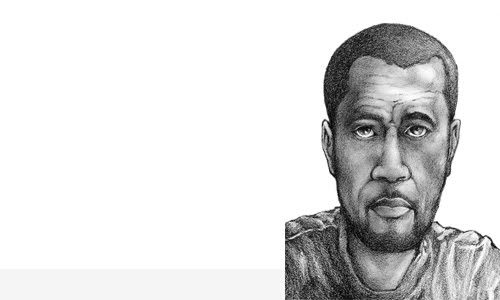
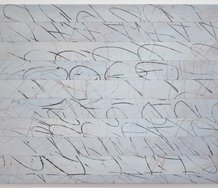
The third is an exhibition of paintings and pencil drawings made by prisoners from Auckland prison and Northern Region Corrections. It is work that varies between the visual equivalents of classical and jazz. Some is mimetic and realistic in aspiration, akin perhaps to classical music that references natural phenomena like landscapes or bird and water sounds. Others are more abstract and grid like. They reference machinery as drawings but also coincidentally mimic jazz and electronic music with their percussive rhythms and parallel rectangular structures.
Knorr’s interest here in physical and pedagogical accessibility reflects an earlier work in the Venice Biennale where visitors were shut out of the Romanian pavillion, or the opposite in Manifesta, where gallery doors were removed. His awareness of other issues such as loss of identity (as enforced with the filmed prisoners) has been demonstrated by other works where black balaclavas were placed over the heads of public statues.
With this show there is an assumption that musical (or artistic) talent only becomes clearly manifest in those privileged enough to have had a good education – but that is not always the case. Some people have an innate biological ability to copy or invent melodies or make accurate representations of things - a talent acquired by (genetic) nature not (social) nurture. This fact perhaps helps make the issues of class levelling that Knorr raises here, irrelevant. A superbly thoughtful exhibition nonetheless.
(Above image, Self-portrait by Dave, charcoal on paper, 2009.)
 Advertising in this column
 Two Rooms presents a program of residencies and projects
This Discussion has 0 comments.
Comment
Participate
Register to Participate.
Sign in
Sign in to an existing account.