
John Hurrell – 13 August, 2010
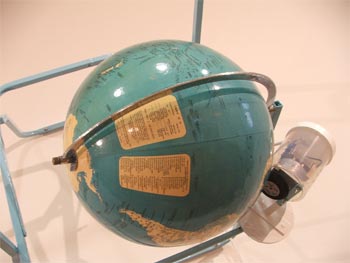
Some show us various properties of our planet, the way it turns for example - though not in orthodox displays of how it is affected by the light and heat of the sun, or how the moon might revolve around it. Instead the map covered globe is pushed over on its side and fastened to the wall in the metal frame of a chair, so that an electric motor can slowly revolve it through pressure from a rubber wheel.
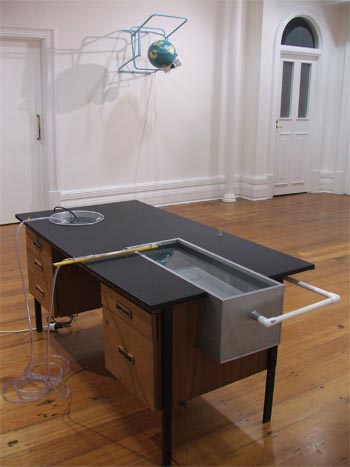
The first made in 1995 and the last completed this year, these six motorised sculptures by Paul Cullen dominate the three small gallery spaces at Jane Sanders. He has constructed sixteen such works over the years while working on other projects at the same time, and when you examine them, each with their seemingly casual assembling, each sculpture demonstrates circulating movement, turning objects or water around in cycles set up in (or on) modified furniture. Various chairs, desks, tables and stools adapted for science.
Some show us various properties of our planet, the way it turns for example - though not in orthodox displays of how it is affected by the light and heat of the sun, or how the moon might revolve around it. Instead the map covered globe is pushed over on its side and fastened to the wall in the metal frame of a chair, so that an electric motor can slowly revolve it through pressure from a rubber wheel.
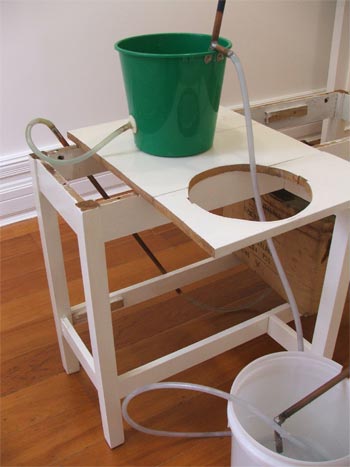
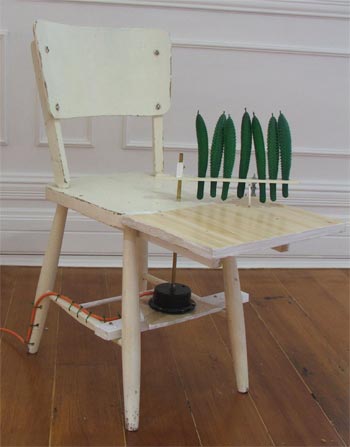
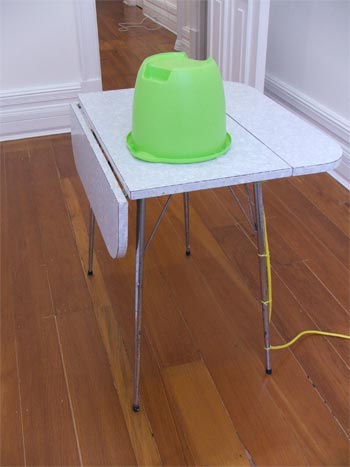
Others present a couple of gallons of engine-pumped water coursing through some wonky conduits of plastic tubing woven in and around a desk with a set in sink or ignored cut out bucket-hole: a symbol perhaps for the planet’s revolving ocean currents, or water eco-systems. Drier displays include a revolving arm of lined up plastic gherkins that look like yew trees or cacti jammed into a tiny irrigation machine embedded in a chair with an extended seat, or an inverted bucket that squeakily shudders and lurches around a Formica table top.
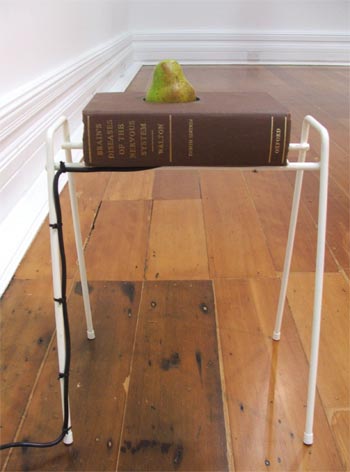
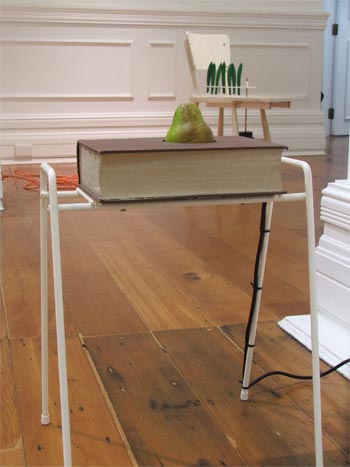
One sculpture, a thick book of ‘Brain’s Diseases of the Nervous System’ lying closed on a stand of metal table legs, has a hole cut out of its top cover in which is placed a revolving plastic pear. The fruit seems to be an escaping organ wiggling out of the detailed medical descriptions imprisoning it within the text and seeking liberation by burrowing its way out of the cardboard and paper.
Cullen milks the humour and speculative nature of these eccentric arrangements like a crazed teacher so in love with the physical attributes of his demonstrations he has forgotten the original principle he was attempting to show. In fact the fascination with these properties of motion is a little similar to the way autistic children can be obsessed with running taps, the fanning pages of phonebooks etc. The rapid, pressurised movement of the vertical liquid or the swelling expansion of the flickering paper pages is hypnotic, like flames in a fire.
This sort of movement (the visible physicality of fixed circulations and cycles) is not orchestrated like say Len Lye works are, set into stages, but is constant - an eternal present that is unrelenting. That means you can lock into one detail of the work and just watch it in isolation for its temporal and kinetic consistency. There is no complicated programme providing preplanned theatricality, only your investigative eye that can then move from point to point around these appealingly simple works, making causal connections, spotting spouts pouring into buckets, tied in wiring holding motors, tubes running from pumps etc.
So whilst this is a typically amusing Cullen exhibition with its Heath Robinsonish improvisations and bizarre juxtapositions, it also provides ‘serious’ pleasure in the sense that such self-contained systems are an interesting reflection of the natural world - and cultural and economic ones too: looping or revolving metaphors for the various micro and macro systems within and without us. A wonderful show.
John Hurrell
 Advertising in this column
 Two Rooms presents a program of residencies and projects
This Discussion has 0 comments.
Comment
Participate
Register to Participate.
Sign in
Sign in to an existing account.