


John Hurrell – 20 November, 2024
Roundtree Williams obviously likes symbols, usually precisely drawn with careful contours. The recent paintings almost always contain lighthouses within their iconography, perhaps as a conspicuous symbol of hope, a guiding beacon to help others avoid danger, one designed to be seen far more than as an aid for looking—focussing on the nature of the reflective inner-examining self. There is a wide range of interpretative possibilities.
The last time I wrote about Sam Rountree Williams was in September 2011. A show in St David’s Church. My third review of his work. One that generated a run of comments.
In this current presentation, Rountree Williams’ appropriated title alludes to the landmark 1992 touring NZ survey that went to Sydney. With that moniker, it also emphasises the importance of thought in art production and art interpretation.
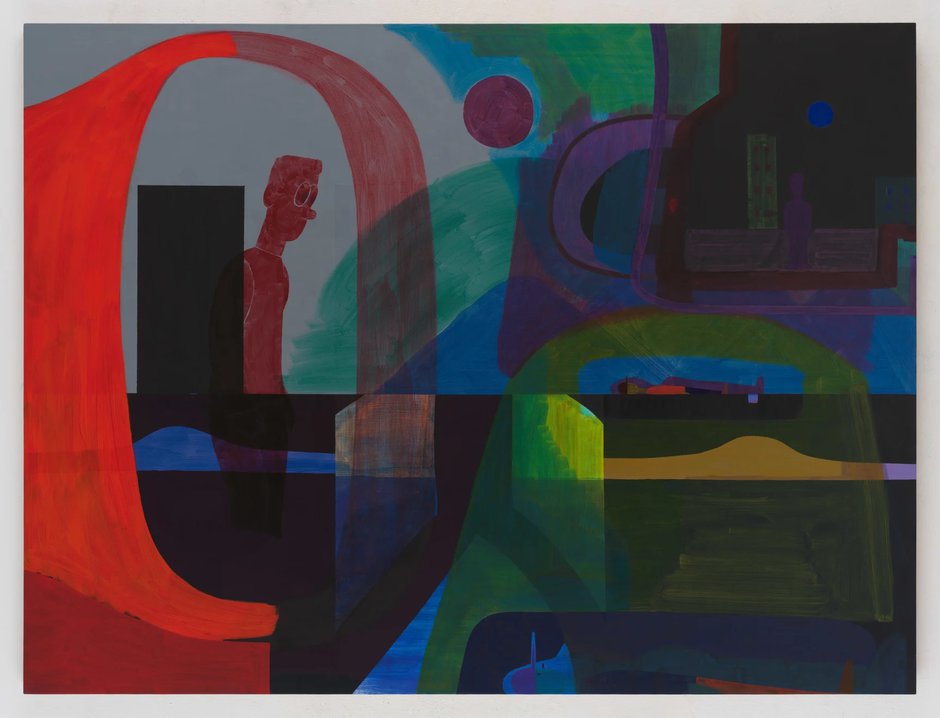
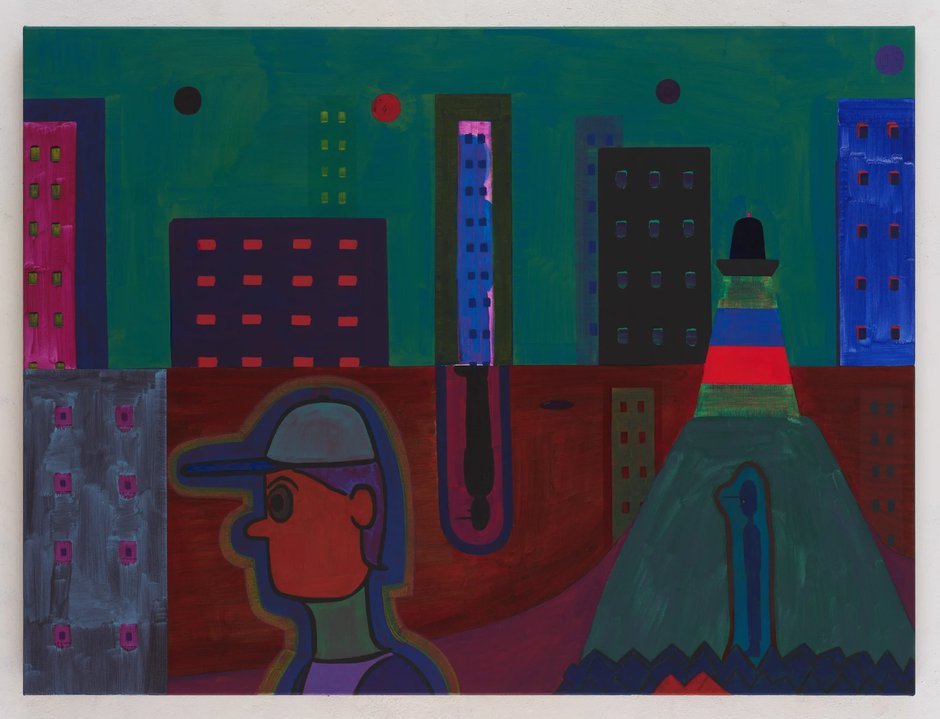
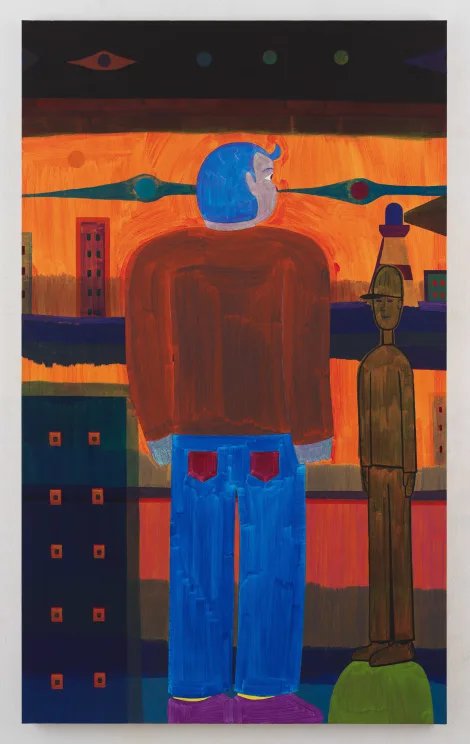
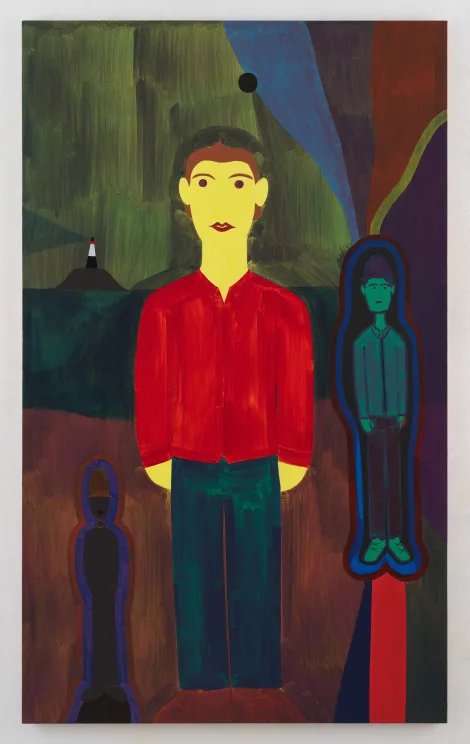
Rountree Williams has been living in Berlin for many years now. The works of this show, unlike those presented in some earlier exhibitions, do not reveal spray-painted canvas surfaces dominated by Danish cockle shells. Instead he presents trios (or more) of clothed male figures, meticulously outlined with loosely brushed thin paint placed within. These stiffly vertical or supine chappies (a hint of clothes-peg dolls but with baseball caps) could be self-portraits, but not necessarily. Maybe images of how a typical male self as seen by others and how it might be seen looking at itself.
These might be connected to the earlier mentioned shell works where we saw exposed their empty insides, the shells glued on and painted over to provide a densely textured field of little ‘containers’.
Those hollow encrustations could have been seen as vessels. For what? Invisible spirit perhaps? Soulful ‘interiority’? Individual human essence?
Roundtree Williams obviously likes symbols, usually precisely drawn with careful contours. The seven recent paintings almost always contain lighthouses within their iconography, perhaps as a conspicuous symbol of hope, a guiding beacon to help others avoid danger, one designed to be seen far more than as an aid for looking—focussing on the nature of the reflective inner-examining self. There is a wide range of interpretative possibilities.
Most of these symbols are preplanned, with small and large motifs effortlessly mingled, but a few seem improvised. Balanced symmetrical compositions are the norm. Some of these ‘lighthouses’ are swelling cones that even seem like termite mounds with small rotating beams on top, implying the visible self has an unseen collection of multiple energies seething within its fecund and bulbous base.
The style of these paintings is akin to some comicbooks, though the narrative here is obviously compressed, several sequential frames now merged into one—particularly in the horizontal works. Tonal contrast of glowing shape is a dominant compositional device. Their scale is imposing while remaining intimate.
My favourite work is the Headlands painting. I like the fact that the elegant shapes suggest overlapping uppercase letters, and I greatly enjoy the Dagwood style figure.
Of the two rectangular formats I greatly prefer the horizontal one with the wider vista. It is more spectacular. The vertical version seems too crammed, with not enough space around the enclosed figure.
Perhaps that is deliberate, as a subtle comment on the restraints society places on the solo individual, or maybe an attitude presented here with sneaky irony. The latter is feasible, especially with the bulbous lighthouses present in the same show. A community-oriented ethos is possible.
John Hurrell
.
 Two Rooms presents a program of residencies and projects
 Advertising in this column
This Discussion has 0 comments.
Comment
Participate
Register to Participate.
Sign in
Sign in to an existing account.