

John Hurrell – 17 July, 2017
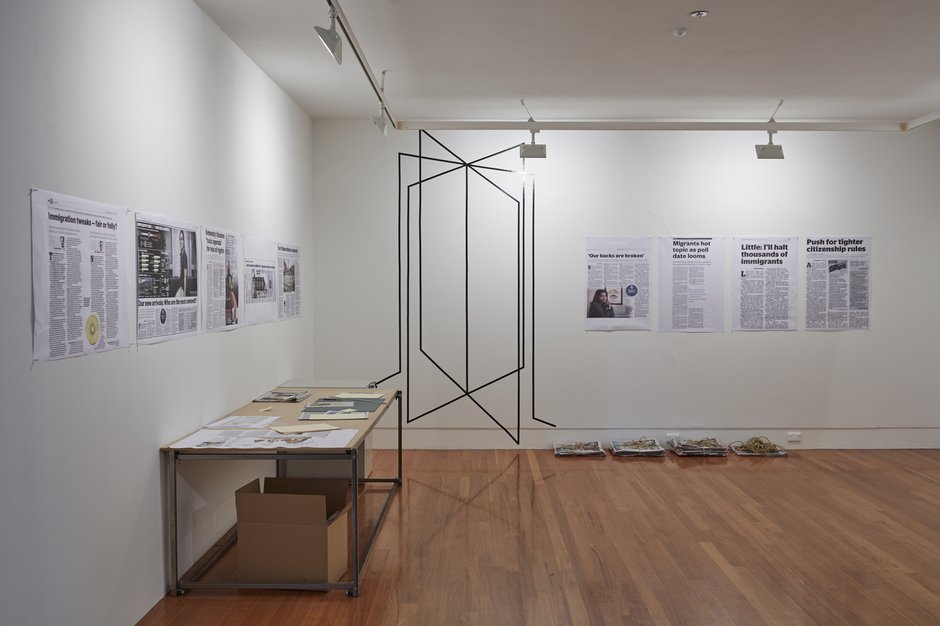
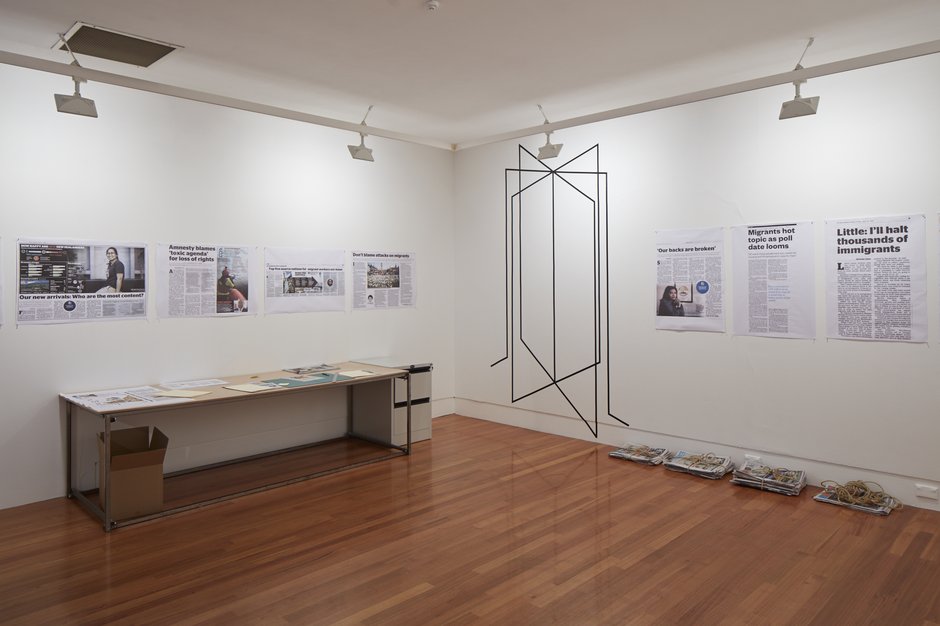
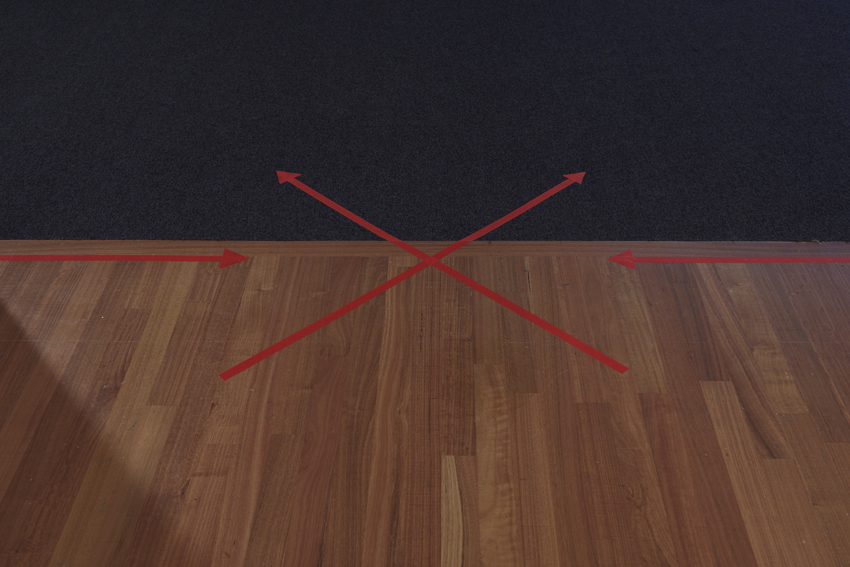
In his gallery installation Barber cleverly uses tape to make two drawings. On the wall opposite the entrance is a linearly rendered turnstile, a symbol for gaining official permanent access, passing through our borders, accepting the prerequisite restrictions, and being absorbed into our multi-cultural community…On the floor of the entrance/exit itself is a diagram of vectors, a St. Andrew's cross of two intersecting diagonal arrows pointing outwards: to the left and to the right.
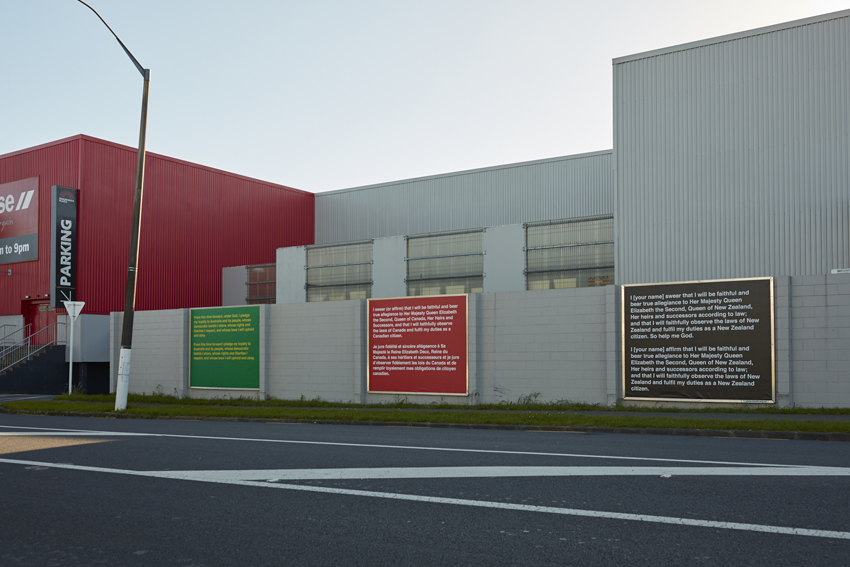
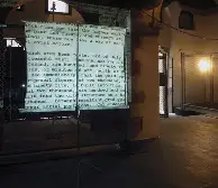
The title of this show refers to the oath of allegiance that new citizens have to make to formally acquire a new nationality. The wording of such pledges for the commonwealth countries of Australia, Canada and New Zealand is set out by ex-pat Bruce Barber on the three billboards positioned opposite the Te Tuhi entrance so that the nuances of language (and vestiges of colonialism) can be studied, while inside the Te Tuhi building in one of the small galleries, Barber allows us to think about media coverage of migrants, citizenship and immigration - a hot topic with an election coming up, and a subject with which all the leaders of our main political parties tend to get their fingers burnt, even James Shaw of the Greens. The subject is a ‘tar baby’ that sticks to any fingers that grasp it. Barber is interested in how newspapers in particular influence public opinion.
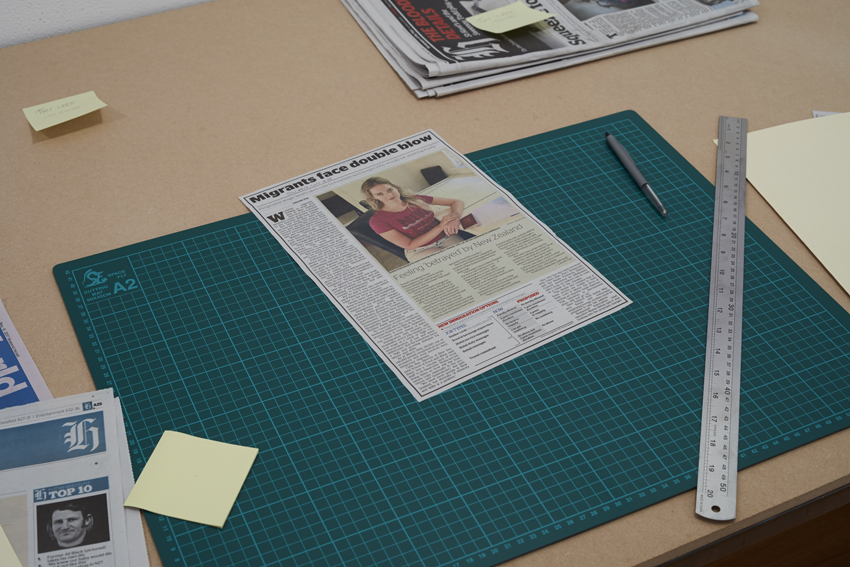
In his gallery installation Barber cleverly uses tape to make two drawings. On the wall opposite the entrance is a linearly rendered turnstile, a symbol for gaining official permanent access, passing through our borders, accepting the prerequisite restrictions, and being absorbed into our multi-cultural community. Members of the public are invited to go the latest NZ Herald that is made available, cut out pertinent articles where debate is occurring or contentious statements are being made, enlarge them with a photocopier and pin them on the wall. Later they will be filed in an archive cabinet. The Heralds are collected up in bundles so the remnants can be reused if necessary.
On the floor of the entrance/exit itself is a diagram of vectors, a St. Andrew’s cross of two intersecting diagonal arrows pointing outwards: to the left and to the right as political symbols. Leaving that space after reading or viewing some of the material (there are slides from television news clips too), gallery visitors are likely to be planning their electoral vote, as well as ruminating over current affairs issues such as Brexit, Trump’s travel ban, our welcoming or rejection of refugees from Syria and other parts of the world, and whether Aotearoa New Zealand should reduce or increase the number of new citizens anyway (from over all the planet or from specific global regions).
Barber himself claims to take a neutral position, in the sense that he is setting up the availability of information - and not promoting his own personal political opinions. However it could be argued that the implication of the billboard presentation being concurrent with the gallery project (and being so physically separated) is that sworn-in citizens of any nation have a responsibility to look out globally for the welfare of non-citizens who are disadvantaged in some way - as well as those who want to come here and contribute to our community - and that New Zealand Aotearoa has plenty of room on both islands for anybody who wants to come, live and work here.
The space between the two displays suggests that isolated insularity is impossible. With exhibition visitors serving as symbols, they ‘come in’ through the ‘turnstile’ on the wall and look out at the wider world or the New Zealand world (you can interpret it both ways) through the doorway. With either approach they find they have an obligation to look outwards and not to perpetuate a globally-restricted, Pacific-inclusive hermeticism.
John Hurrell
 Two Rooms presents a program of residencies and projects
 Advertising in this column
This Discussion has 0 comments.
Comment
Participate
Register to Participate.
Sign in
Sign in to an existing account.